
Bring your field question into focus
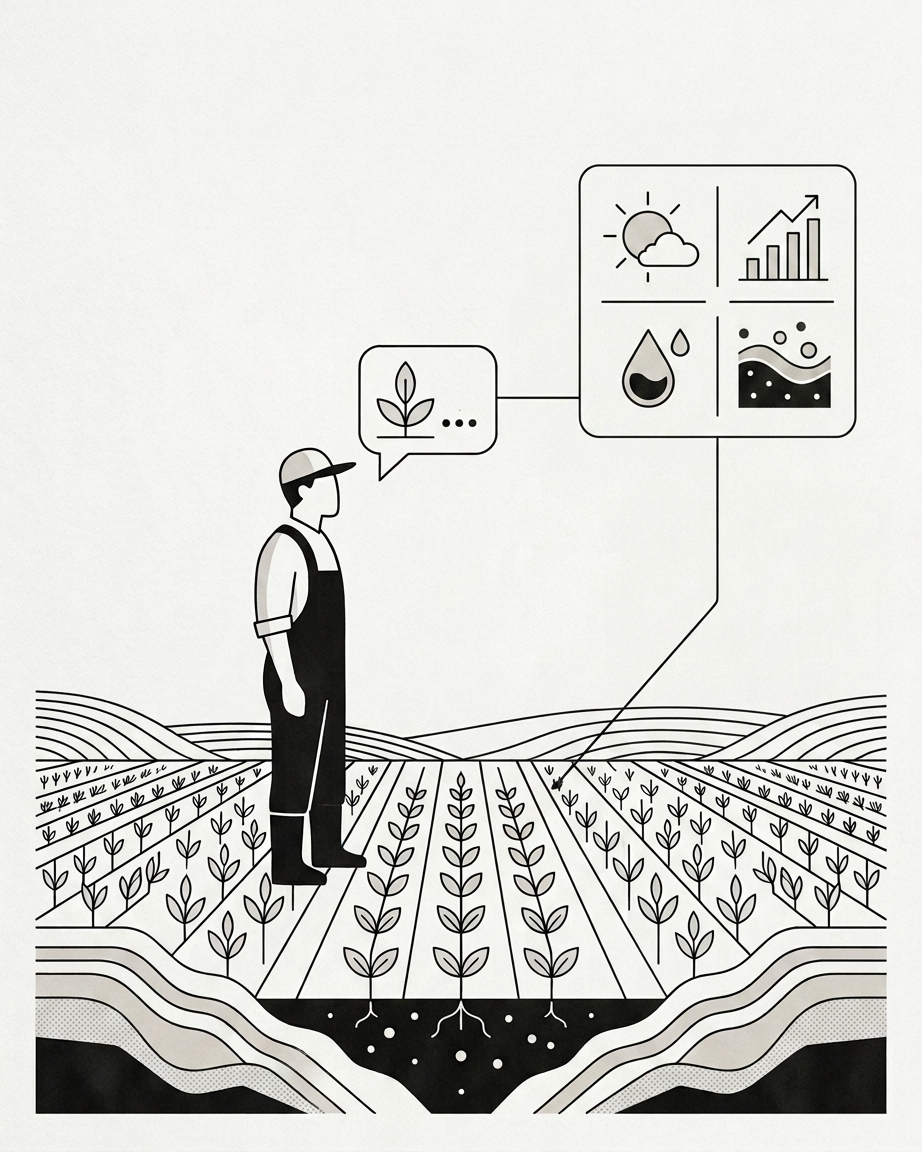
A change in the crop or a soil reading often raises a practical question: what does this mean for the next operation? Sensorius Agronomic Adviser helps you discuss that question using the field information available to your account. Your team can explore the reasons behind a suggestion before deciding how to respond. You can discuss your field data with an AI agronomist. You add the local knowledge that matters: what was done, what you see in the crop and what the farm needs to decide.
AI Agronomist for Field Decisions
Two examples of a field conversation
These examples are illustrative. They do not report a Sensorius pilot result or establish that a particular agronomic action is appropriate.
Prepare an inspection after a measurement changes
On a field with an installed sensor, the team notices a change in readings. It asks about the period and recent work, then reviews available measurements, forecast and history to prepare a list of information to check.
The user asks which explanation is based on an observation and which remains uncertain. The team decides what to inspect and who should check it. The visit can compare conditions near the sensor with the area of interest and confirm recent operations. The cause is assessed from the evidence together, not inferred from the chat alone.
Discuss the information before the next irrigation
An operator wants to know what to prepare before discussing irrigation. Where a soil sensor is installed, the team reviews moisture readings with operation history and the available forecast. The question is about the evidence and checks needed before deciding.
After the conversation, the team assesses the crop, equipment and local conditions. The user decides the timing and rate. If compatible equipment is installed, an operator separately controls it through Sensorius and checks the feedback. The consultation does not send the command.
Get a conversation grounded in your field
General advice can leave a team wondering how it applies to a particular crop, season or operation. The Sensorius Agronomic Adviser can use permitted field information through the tools available to your account. Where available, stored forecasts, measurements, crop timelines and work records help the adviser address your question.
You can ask how the advice relates to your field. You can ask what supports a suggested action, which conditions matter and what needs clarification. The answer depends on the information the adviser can access. An observation from your agronomist or operator may add something that the records alone do not show.
Understand the reasoning before committing resources
An operation uses staff time, machinery and often purchased inputs. Before committing those resources, your team needs to understand why an action is being considered and whether the reasoning fits the field. The adviser explains its reasoning using the available information.
You can use the conversation to separate what is known from what still needs a field check. A useful consultation clarifies the question and helps the team decide what to check next. A detailed answer alone does not establish a diagnosis. Decisions involving crop treatment or other agronomic interventions still require the relevant field assessment and professional judgment.
Keep the question close to the work
The most useful starting point is a question your team already needs to answer. That might concern changing soil conditions before irrigation, why an action was suggested or how recent work relates to crop development. A focused question gives the conversation a practical purpose.
Sensorius can suit teams that regularly gather field information for planning meetings or consultations. The farm manager can explain the decision and the staff, machinery and inputs it would need. The agronomist can add crop observations. Start with how your team works today to decide where advice would help. You can use the consultation in that process, with your team responsible for the action.
Connect an immediate question with the season
A question about tomorrow's work often depends on where the crop sits in the season. Field advisor helps prepare a crop timeline after you review the details and confirm that you want to continue. The timeline gives the team a reference for discussing the expected sequence of crop development and associated actions.
The general Agronomic Adviser chat is the place for advisory questions. Field advisor is the separate tool for preparing a crop timeline. Keeping those roles clear lets you choose the appropriate support: discussing a field question or preparing the seasonal reference that informs later decisions. Neither role assigns staff or machinery on your behalf.
Add measurements where they answer a real question
Your first consultation can use existing field and work records. A soil sensor becomes relevant when local measurements would add context to a recurring question. For a field with an installed sensor, the adviser can discuss readings available through its supported tools alongside the other field information.
Measurements describe their location and time. They should be considered with the crop and the field's variation. Sensors give the discussion additional detail; they do not establish that every part of the field has the same conditions. We can discuss the information you already have before considering whether more measurements are needed.
Keep equipment control with the operator
Advice and an equipment command are separate parts of the farm's work. An operator can control compatible irrigation or fertigation equipment through Sensorius where the required control device is installed and commissioned. Installation, safety and completion-feedback checks belong to that operator process.
The Agronomic Adviser chat does not send device commands. An autonomous agent is planned, with no announced date or approved set of autonomous actions. Today you can ask for advice and prepare a crop timeline. An operator can control compatible equipment separately through the supported control interface.
Start with a question worth answering
Bring one field question, crop and season details, recent operations and any observations your team wants to discuss. We can consider what information is available and where an adviser conversation could fit. A first discussion can also identify whether you need a laboratory result, another observation or an installed measurement source before deciding on an intervention.
Get a conversation grounded in your field
General advice can leave a team wondering how it applies to a particular crop, season or operation. The Sensorius Agronomic Adviser can use permitted field information through the tools available to your account. Where available, stored forecasts, measurements, crop timelines and work records help the adviser address your question.
You can ask how the advice relates to your field. You can ask what supports a suggested action, which conditions matter and what needs clarification. The answer depends on the information the adviser can access. An observation from your agronomist or operator may add something that the records alone do not show.
Understand the reasoning before committing resources
An operation uses staff time, machinery and often purchased inputs. Before committing those resources, your team needs to understand why an action is being considered and whether the reasoning fits the field. The adviser explains its reasoning using the available information.
You can use the conversation to separate what is known from what still needs a field check. A useful consultation clarifies the question and helps the team decide what to check next. A detailed answer alone does not establish a diagnosis. Decisions involving crop treatment or other agronomic interventions still require the relevant field assessment and professional judgment.
Keep the question close to the work
The most useful starting point is a question your team already needs to answer. That might concern changing soil conditions before irrigation, why an action was suggested or how recent work relates to crop development. A focused question gives the conversation a practical purpose.
Sensorius can suit teams that regularly gather field information for planning meetings or consultations. The farm manager can explain the decision and the staff, machinery and inputs it would need. The agronomist can add crop observations. Start with how your team works today to decide where advice would help. You can use the consultation in that process, with your team responsible for the action.
Connect an immediate question with the season
A question about tomorrow's work often depends on where the crop sits in the season. Field advisor helps prepare a crop timeline after you review the details and confirm that you want to continue. The timeline gives the team a reference for discussing the expected sequence of crop development and associated actions.
The general Agronomic Adviser chat is the place for advisory questions. Field advisor is the separate tool for preparing a crop timeline. Keeping those roles clear lets you choose the appropriate support: discussing a field question or preparing the seasonal reference that informs later decisions. Neither role assigns staff or machinery on your behalf.
Add measurements where they answer a real question
Your first consultation can use existing field and work records. A soil sensor becomes relevant when local measurements would add context to a recurring question. For a field with an installed sensor, the adviser can discuss readings available through its supported tools alongside the other field information.
Measurements describe their location and time. They should be considered with the crop and the field's variation. Sensors give the discussion additional detail; they do not establish that every part of the field has the same conditions. We can discuss the information you already have before considering whether more measurements are needed.
Keep equipment control with the operator
Advice and an equipment command are separate parts of the farm's work. An operator can control compatible irrigation or fertigation equipment through Sensorius where the required control device is installed and commissioned. Installation, safety and completion-feedback checks belong to that operator process.
The Agronomic Adviser chat does not send device commands. An autonomous agent is planned, with no announced date or approved set of autonomous actions. Today you can ask for advice and prepare a crop timeline. An operator can control compatible equipment separately through the supported control interface.
Start with a question worth answering
Bring one field question, crop and season details, recent operations and any observations your team wants to discuss. We can consider what information is available and where an adviser conversation could fit. A first discussion can also identify whether you need a laboratory result, another observation or an installed measurement source before deciding on an intervention.
Common questions
What kinds of questions can we discuss?
Start with the field decision in front of you: the context of a suggested operation, a change in measurements or the relationship between weather and upcoming work. Access to supporting data depends on the tools and information available to your account.
Do we need Sensorius devices first?
You can begin with existing field records and an available forecast. Devices add local measurements where those readings help answer your question. The initial conversation can help identify that need without requiring sensors on every field.
Does the adviser inspect satellite images?
The field page can show acquired RGB Sentinel-2 scenes when available. Image analysis by the adviser is not established. You can describe your observations in a conversation, but do not assume it has inspected the scene.
Can the adviser start irrigation?
The chat provides advice and does not issue device commands. Remote control is a separate operator action using supported, correctly installed equipment and the agreed safety and confirmation process.
How do we assess the value of the consultation?
Choose a recurring question and agree what a useful answer would help the team understand. Any claim of reduced staff time, input use or cost needs your own measured comparison and approved evidence.
Bring one field question to the conversation
Choose a decision your team is preparing and note what information is already available. We can discuss the field context, the role of the Adviser and what should remain a human check.
Description of Sensorius Agronomic Adviser explains the product. See the related data workflow for nutrition and irrigation.
Plan the season and upcoming field work · Discuss future MCP integrations
From a field question to an informed decision

Get a conversation grounded in your field
General advice can leave a team wondering how it applies to a particular crop, season or operation. The Sensorius Agronomic Adviser can use permitted field information through the tools available to your account. Where available, stored forecasts, measurements, crop timelines and work records help the adviser address your question.
You can ask how the advice relates to your field. You can ask what supports a suggested action, which conditions matter and what needs clarification. The answer depends on the information the adviser can access. An observation from your agronomist or operator may add something that the records alone do not show.
Understand the reasoning before committing resources
An operation uses staff time, machinery and often purchased inputs. Before committing those resources, your team needs to understand why an action is being considered and whether the reasoning fits the field. The adviser explains its reasoning using the available information.
You can use the conversation to separate what is known from what still needs a field check. A useful consultation clarifies the question and helps the team decide what to check next. A detailed answer alone does not establish a diagnosis. Decisions involving crop treatment or other agronomic interventions still require the relevant field assessment and professional judgment.
Add measurements where they answer a real question
Your first consultation can use existing field and work records. A soil sensor becomes relevant when local measurements would add context to a recurring question. For a field with an installed sensor, the adviser can discuss readings available through its supported tools alongside the other field information.
Measurements describe their location and time. They should be considered with the crop and the field's variation. Sensors give the discussion additional detail; they do not establish that every part of the field has the same conditions. We can discuss the information you already have before considering whether more measurements are needed.
Discuss a field question with the right context
Field context
Ground field advice in permitted records.
Decision reasoning
Review reasoning before committing resources.
Local measurements
Add local measurements when they answer a question.
Get a conversation grounded in your field
General advice can leave a team wondering how it applies to a particular crop, season or operation. The Sensorius Agronomic Adviser can use permitted field information through the tools available to your account. Where available, stored forecasts, measurements, crop timelines and work records help the adviser address your question.
You can ask how the advice relates to your field. You can ask what supports a suggested action, which conditions matter and what needs clarification. The answer depends on the information the adviser can access. An observation from your agronomist or operator may add something that the records alone do not show.

Understand the reasoning before committing resources
An operation uses staff time, machinery and often purchased inputs. Before committing those resources, your team needs to understand why an action is being considered and whether the reasoning fits the field. The adviser explains its reasoning using the available information.
You can use the conversation to separate what is known from what still needs a field check. A useful consultation clarifies the question and helps the team decide what to check next. A detailed answer alone does not establish a diagnosis. Decisions involving crop treatment or other agronomic interventions still require the relevant field assessment and professional judgment.

Add measurements where they answer a real question
Your first consultation can use existing field and work records. A soil sensor becomes relevant when local measurements would add context to a recurring question. For a field with an installed sensor, the adviser can discuss readings available through its supported tools alongside the other field information.
Measurements describe their location and time. They should be considered with the crop and the field's variation. Sensors give the discussion additional detail; they do not establish that every part of the field has the same conditions. We can discuss the information you already have before considering whether more measurements are needed.

Common questions
What kinds of questions can we discuss?
Start with the field decision in front of you: the context of a suggested operation, a change in measurements or the relationship between weather and upcoming work. Access to supporting data depends on the tools and information available to your account.
Do we need Sensorius devices first?
You can begin with existing field records and an available forecast. Devices add local measurements where those readings help answer your question. The initial conversation can help identify that need without requiring sensors on every field.
Does the adviser inspect satellite images?
The field page can show acquired RGB Sentinel-2 scenes when available. Image analysis by the adviser is not established. You can describe your observations in a conversation, but do not assume it has inspected the scene.
Can the adviser start irrigation?
The chat provides advice and does not issue device commands. Remote control is a separate operator action using supported, correctly installed equipment and the agreed safety and confirmation process.
How do we assess the value of the consultation?
Choose a recurring question and agree what a useful answer would help the team understand. Any claim of reduced staff time, input use or cost needs your own measured comparison and approved evidence.
Bring one field question to the conversation
Choose a decision your team is preparing and note what information is already available. We can discuss the field context, the role of the Adviser and what should remain a human check.
Description of Sensorius Agronomic Adviser explains the product. See the related data workflow for nutrition and irrigation.
Plan the season and upcoming field work · Discuss future MCP integrations
Related guides and solutions
Season and field planning, nutrition and irrigation and crop inspections show where consultation can fit. The Agronomic Adviser product page describes the current product. All Sensorius solutions.
Discuss the question your team keeps returning to
Tell us which field decision needs more information or a clearer explanation. We can discuss the available information and how the Sensorius Agronomic Adviser could support your team.
Discuss a field questionStart with a question worth answering
Bring one field question, crop and season details, recent operations and any observations your team wants to discuss. We can consider what information is available and where an adviser conversation could fit. A first discussion can also identify whether you need a laboratory result, another observation or an installed measurement source before deciding on an intervention.
Discuss a field questionPowiązane poradniki i rozwiązania
Planowanie sezonu, nawożenie i nawadnianie oraz lustracje upraw pokazują zastosowanie konsultacji. Strona produktu Agronomic Adviser opisuje obecne możliwości. Wszystkie rozwiązania Sensorius.
Omów pytanie, do którego zespół regularnie wraca
Powiedz nam, która decyzja potrzebuje dodatkowych informacji lub jaśniejszego wyjaśnienia. Omówimy dostępne dane i sposób, w jaki Sensorius Agronomic Adviser może pomóc zespołowi.
Guias e soluções relacionados
O planeamento da campanha, nutrição e rega e as inspeções mostram aplicações da consulta. A página Agronomic Adviser descreve o produto atual. Todas as soluções Sensorius.
Discuta a questão a que a equipa volta regularmente
Diga-nos que decisão precisa de mais informação ou explicação. Podemos discutir os dados disponíveis e como o Sensorius Agronomic Adviser poderia ajudar a equipa.
Guías y soluciones relacionadas
Planificación, nutrición y riego e inspecciones muestran dónde encaja la consulta. La página Agronomic Adviser describe el producto actual. Todas las soluciones Sensorius.
Comenta la pregunta que se repite en el equipo
Cuéntanos qué decisión necesita más datos o una explicación clara. Podemos comentar la información y cómo Sensorius Agronomic Adviser podría apoyar al equipo.
Start with a question worth answering
Bring one field question, crop and season details, recent operations and any observations your team wants to discuss. We can consider what information is available and where an adviser conversation could fit. A first discussion can also identify whether you need a laboratory result, another observation or an installed measurement source before deciding on an intervention.
Discuss a field question