Technology & Platform

The cloud-native platform scales effortlessly from small farms to regional or national deployments

Our cloud-native Sensorius Platform scales effortlessly — from a handful of sensors in a single field to tens of thousands of devices spread across entire regions. Built with microservices architecture, Kafka streaming, and TimescaleDB time-series analytics, it handles millions of soil readings per day with ease.

As farms and distributors expand, the system automatically balances workloads, keeps data flowing in real time, and delivers instant insights through intuitive dashboards. Whether you manage 10 ha or 10 000 ha, Sensorius ensures the same reliability, speed, and precision — turning every soil sensor into part of a single intelligent network.

The AI-driven IoT platform for soil intelligence

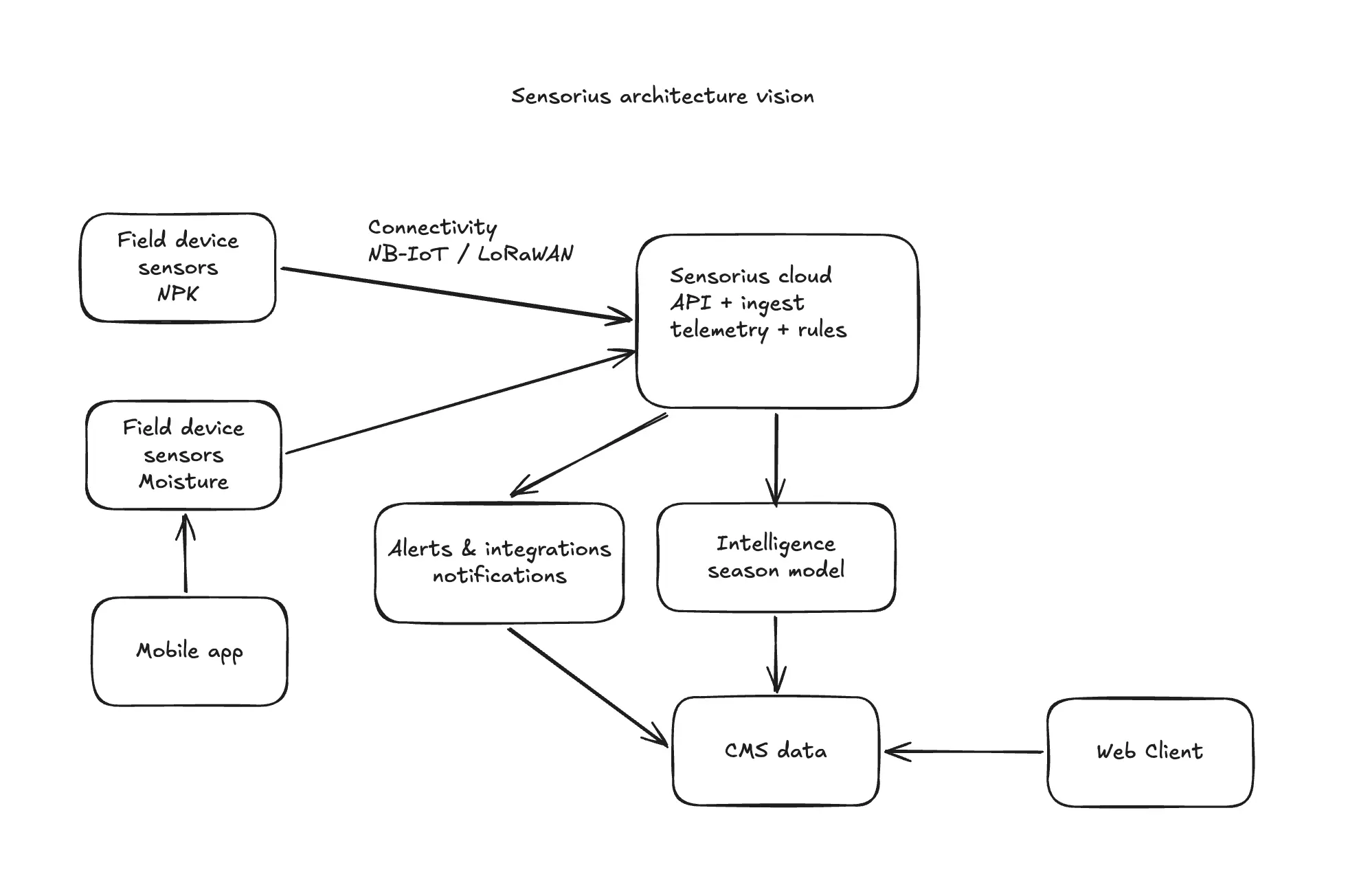
Our IoT sensors support cellular network protocols such as NB-IoT and LTE-M, allowing for optimal performance across different regions.

These protocols are optimized for low data rates, extended battery life, and deep coverage, making them ideal for usage in remote rural areas. Their simplicity and efficiency also contribute to lower operational costs, making them ideal for large-scale IoT deployments.

NB-IoT uses minimal bandwidth and power making it possible for our devices to run for years on a single battery. The technology allows us to seamlessly control sensors that are scattered over a vast area (500ha and more). Using NB-IoT, each sensor can send their readings back to the Sensorius platform, no matter how isolated they are.

This makes it easy to monitor large agricultural fields more effectively.

NB-IoT is very robust as it’s designed to ensure reliable communication even in challenging conditions. It allows our sensors to be installed in harsh conditions for extended periods of time without any maintenance.

Our machine learning (ML) algorithms use diverse data inputs to predict soil fertility and crop deficiencies, achieving high accuracy through robust algorithms and meticulous feature engineering. The effectiveness of our models is further amplified by incorporating localized and contextual data, such as soil type, climate, and historical agricultural practices, which move beyond raw sensor readings to provide a complete picture of the farm environment.

Our AI solutions employ the Law of the Minimum, established by Justus von Liebig, to rank all the identified deficiencies by their limiting effect on potential yield, making the recommendations highly actionable, economically efficient, and impactful for the farmer.

Finally, all the farmer actions are recorded and combined with the end of season harvest report, closing the feedback loop and fueling further improvement of our recommendations engine that keeps learning from every feedback loop.

AI/ML: Regional knowledge base + soil/crop best-practice graphs → predictive models for fertility, yield risk, and irrigation; KPI rigor (R²/RMSE), TRL2→4 plan, and feedback loop from harvest data.

Let's discuss how we can build the future of farming together

Get in touch
Copyright 2025 © Sensorius